Finding the on switch again
I’m writing this after two breaks, back-to-back, which is lovely in theory and a bit less lovely when you consider the packing, unpacking, washing, repacking and staring into a suitcase wondering why everything you own suddenly looks wrong.
The first was a few days away with my mum for some proper mum-daughter time and the second was a holiday with friends. Both were brilliant, and both had slightly different holiday modes attached to them.
For the first one, I wanted to stay gently in touch with work. Not glued to my inbox, not pretending to be off while actually responding to everything, but aware enough to know if anything genuinely needed me. For the second one, I was much more switched off. Much!
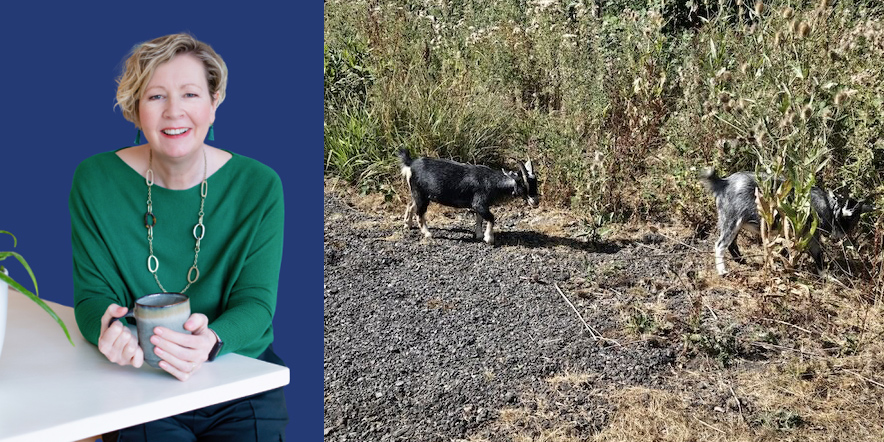
At one point, a colleague messaged me on WhatsApp about a meeting, which felt fair enough because WhatsApp is not exactly the same as opening Outlook and inviting the whole working day back into your brain. I replied with a quick explanation that I was having coffee at a lovely nature reserve where goats were strolling around and followed it up with a photo of said goats.
As out-of-office responses go, I can recommend it.
It also got me thinking about holiday modes because I don’t think there is just one “right” way to be away from work.
What happens when you’ve managed to step away, even for a little while, and then have to find your way back in again?In the last Big Fish Bites, I wrote about the feeling of having a busy brain and an empty tank, especially over the summer when work, life admin and the mythical “quiet period” all collide. This feels like the next bit of that conversation: what happens when you’ve managed to step away, even for a little while, and then have to find your way back in again?
Holiday mode one: still half at work
Some people find it almost impossible to switch off. They take the laptop, “just” check a couple of emails, keep half an eye on things and then, before they know it, they are firefighting when they were meant to be drinking coffee/cocktails, building sandcastles, reading a book, doing bombs into the pool or, indeed, communing with goats.
Sometimes that happens because work genuinely needs them. Sometimes it happens because they haven’t quite trusted the handover. Sometimes it happens because the habit of being needed is very hard to put down.
I say that with no judgement at all because, like most people who run their own business, I know how tempting it can be to keep one mental finger on the work pulse even when you are technically away.
And sometimes staying lightly in touch is the right call. There are short breaks where a gentle check-in makes the whole thing feel easier, not harder. The problem comes when “lightly in touch” turns into “emotionally back at work”.
Holiday mode two: fully off, no obvious on switch
Then there is the other mode.
You switch off properly. You stop checking. You stop mentally rehearsing replies. You forget what day it is. You have the audacity to enjoy yourself.
Wonderful!
And then you come back.
Suddenly the inbox is there, the meetings are there, the decisions are there, and your work brain appears to have taken a later flight home. You’re back at the desk but part of you is still looking at the goats.
This is the bit I think we don’t talk about enough. We talk a lot about switching off, and rightly so, because most of us need encouragement to do that. But coming back well is a skill too. And it is especially relevant at this point in the year, when lots of people are returning from breaks and beginning to think about September, which has a habit of arriving with a clipboard and a sense of urgency.
The guilt of feeling a bit slow
There can be a strange guilt attached to coming back from holiday and not instantly feeling razor sharp.
You’ve had a break, so surely you should be recharged, grateful, clear-headed and ready to crack on?
Sometimes yes. Sometimes no.
Sometimes you come back refreshed but a bit woolly. Sometimes your brain needs a little bit of time to remember where everything lives. Sometimes the first day back is less about brilliance and more about locating the thread again.
I don’t think that makes you lazy. I think it makes you human!
And if the break has done its job, there may even be a tiny bit of resistance to diving straight back into the exact same habits you were relieved to pause. That resistance might be useful information. It might be telling you that something about the way you work needs a bit of attention before the September pace picks up.
What helps
Of course, coming back well is much easier when you have good people around you.
I am extremely lucky to have brilliant colleagues who keep things moving, support clients properly and make sure training runs smoothly. While I was away, there was still important work happening, including presentation training to support an agency preparing for an important pitch, as well as the usual flow of client queries and course logistics.
That matters because switching off, even partially, is rarely just an individual act of discipline. It is also about clarity, trust and not accidentally making yourself the bottleneck for everything.
If people need you for every decision, every answer and every tiny “what do you think?” moment, going away becomes stressful and coming back becomes worse. You return to a pile of things that have been waiting for your blessing rather than a set of things that have moved forward without you.
That is not always avoidable, of course. Some roles and some moments definitely need more contact than others. But it is worth asking whether the way we prepare to leave makes it easier or harder to return.
The return deserves a plan too
Most of us do at least some planning before we go away. We write lists, finish the urgent things, leave notes, brief colleagues, set the out-of-office and try to remember whether we have packed a phone charger.
But we often give much less thought to the return.
We come back, open the inbox and let the loudest thing decide what happens next.
That might be necessary in a crisis. Most of the time, it just hands your first day back to everyone else’s priorities. Much more stressful!
So, if you are going away, or if you have just come back and are trying to find the on switch again, I think there is something useful in planning the re-entry as well as the exit.
Nothing complicated. You know I’m not going to suggest a 17-step system because I would immediately ignore it myself!
Just one small thing.
A small experiment: the re-entry hour
If you can, protect the first hour (or three, which is what I did, to be fair) of your first proper working day back.
I know this won’t always be possible. Sometimes a client meeting has to happen or a training session is already in the diary. But if you have any control at all, try not to give that first hour away too easily.
Use it to get your bearings before you start responding.
You might ask yourself:
-
What changed while I was away?
-
What needs my attention today?
-
What can wait until tomorrow or later in the week?
-
What has already been handled perfectly well without me?
-
What is one useful thing I can do today that will help me feel back in motion?
I’d also be tempted to add:
- What did I notice while I was away that I don’t want to ignore now I’m back?
That last one might be the most useful of all, because holidays can create just enough distance for us to see things more clearly. It might be a working pattern that has become daft. It might be a meeting that no longer earns its place. It might be a piece of work that needs more attention, or less. It might be the realisation that your team are more capable than you sometimes remember when you’re in the thick of everything.
And yes, it might simply be that you need a cup of tea and a realistic to-do list. Those are ALWAYS the essentials for me.
Looking ahead to September
This feels particularly relevant as we creep towards September.
There is something useful about the back-to-school feeling. It can give us a reason to reset, refocus and make a few choices about how we want the next stretch of the year to feel.
But if we hurtle straight from holiday mode into September mode without a moment to think, we can miss the chance to bring anything useful back with us.
The point of a break is not just to stop working for a bit, although that is obviously important and, frankly, lovely. It can also give you a different vantage point. A little distance from the habits, assumptions and “this is just how we do things” patterns that are hard to spot when you are in them every day.
So if you are coming back from a break, or about to take one, perhaps the useful question is not “How quickly can I get back to normal?”
Perhaps it is:
What do I want to bring back with me, and what do I want to leave behind?


How Big Fish Training Works
Got a team to train? Most courses are delivered direct either in person or via live video for groups of 6 - 12 people. These sessions are tailored to your specific needs. You just need to tell us what they are! Get in touch now for a friendly chat about what you need to achieve.
Want a course just for you? We run special sessions throughout the year and have a growing number of online courses. If you can't find what you need on the site, get in touch now and we can help.
Read More
Sign up for The Hook
Get notified about our next webinar